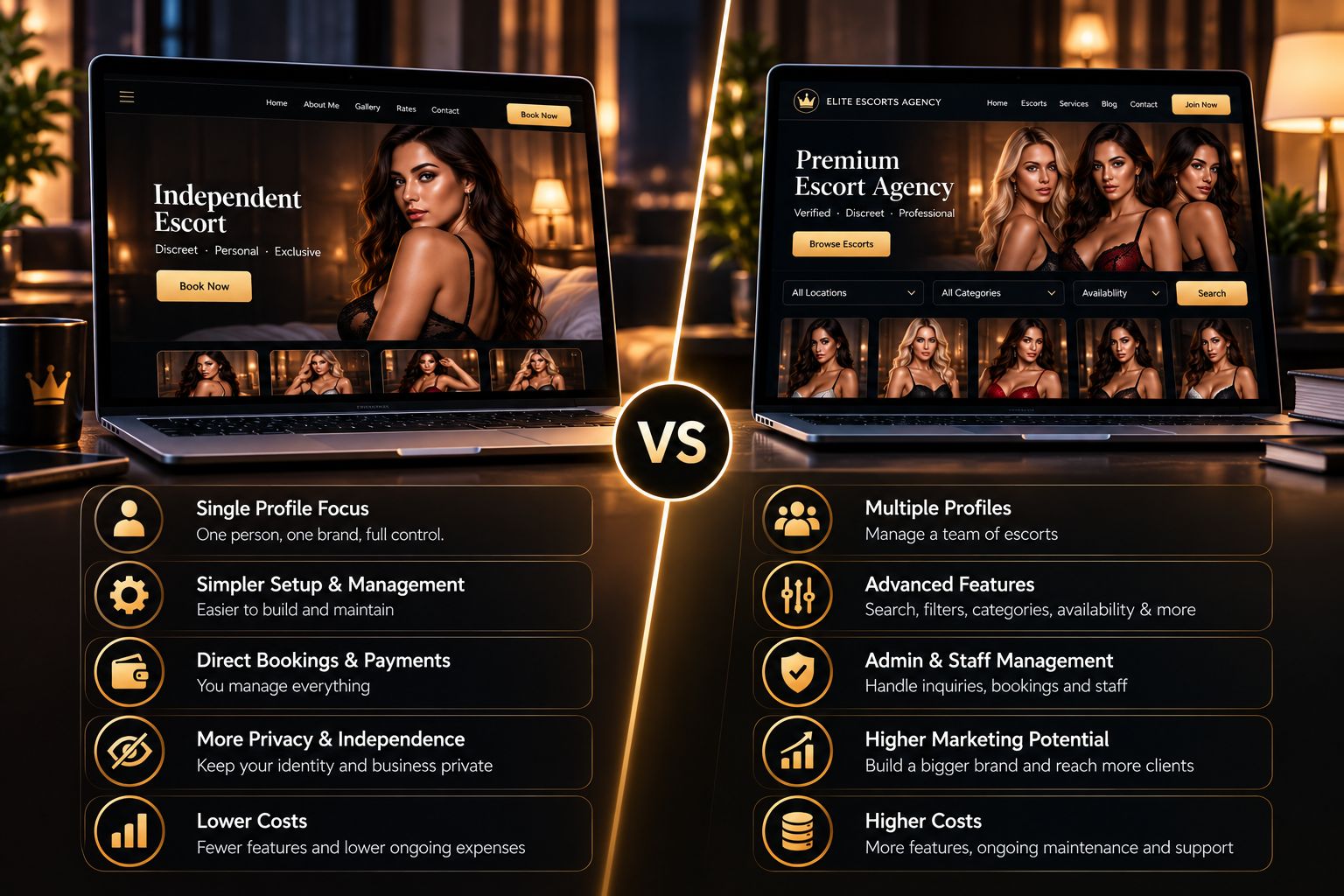
People often think that an independent escort’s site is just a smaller version of an agency site. However, there are some key differences. Yes, there is less complexity in an independent site, but that’s not the only thing that changes as the site size changes. There are plenty of strategic differences as well.
There are also differences when it comes to how each site is structured and the messages it communicates. The biggest differences, however, are seen in how each site is built to function and how they ultimately achieve their goals, including how they are ranked on Google.
Differences in site management
As mentioned, an independent site is more of a personal brand, and as such, it should be structured to reflect that. Because of this, personal sites tend to have more “fluff,” and are longer and more verbose than agency sites. It can be helpful to think of independent site personalities as a combination of multiple agency site profiles. Trying to make an independent site like an agency site typically backfires because personal sites tend to lose their personality when structured like an agency site. For the agency side in full, see our complete guide to escort agency website design.
Differences in site strategies
Because independent operators can’t hope to keep up with an agency site volume strategy, it’s best for them to adopt a quality over quantity strategy. Personal sites should be built to cover a single location in great detail and contain relevant information for long tail searches. Because of declining budgets, personal sites typically can’t keep up with agency sites in the amount of content they produce, so they need to focus on quality rather than quantity.
 Trust signals vary
 Trust signals vary
An agency builds aggregate trust signals (testimonials, employee profiles, case studies, lengthy process descriptions, years in business, etc.) over time. An independent operator builds trust signals through reputation, consistent branding and voice across multiple channels, and available personal information. In fact, an independent operator’s trust signals are often the reason customers choose their services over an agency. This is especially true if the independent operator has a smaller marketing budget than the agency.
Price reflects the difference in complexity
Price is often reflective of the difference in the complexity of the product or service. A detailed analysis of pricing is available in our pricing guide. In short, independent services are typically less expensive to purchase and develop because they usually do not need to manage or employ as many people and do not need to use as many business or administrative programs to help with productivity and organization like an agency does. Before you set a budget, go through these questions to ask before hiring an escort website developer.
Independent services aim to fulfill different SEO needs
Independent services do not try to rank for broad or generic searches like “escort agency in (city)”. They usually try to rank for searches that incorporate the name or recognized brand of the independent service. Achieving rankings for tailored searches for an independent service is usually easier and faster than achieving rankings for broad searches for an agency. This is because, in most cases, the independent service usually does not need to produce as much content as an agency to achieve the desired results. Our guide to escort SEO covers what works for both types of site.
When might an independent operator need agency features?
Most independent operators are happy to remain as such, however some may want to integrate agency-style features to their site as they become larger and more successful. From a technological standpoint, this is fully justifiable; the only difference from an independent operator site would be in the features offered, and not the site infrastructure itself. If you do outgrow a simple site, these are the escort agency website features to add first.
What are the costs and benefits associated with building an independent site versus an agency site?
An independent site is typically less expensive to build compared to an agency site, for the reasons mentioned above. The fundamentals of both site types are similar: user privacy, effective booking, and responsive design to name a few. Whichever you need, see our escort website design services.
Would an independent site benefit from having a blog?
Yes, however, it should be small. A blog can significantly detract from the main site if it is no
Direct Answers
Frequently Asked Questions
An independent website can perform well in SEO when it focuses on a specific location, relevant search terms, and a recognizable personal brand. Agency websites may have more opportunities to target broader keywords and multiple locations. The best option depends on the target audience, competition, content quality, and SEO strategy.
An independent website generally costs less to build because it often requires fewer pages, simpler profile management, and fewer advanced features. An agency website may require additional investment in multi-profile management, search filters, booking systems, and administrative tools. The final cost depends on the design, functionality, hosting, and maintenance requirements.
Yes. An independent website can be expanded by adding structured profiles, location-based pages, advanced search functionality, and booking management features. Planning a scalable website structure from the beginning can make future upgrades easier. Before expanding, review the technical requirements, privacy considerations, and applicable laws and hosting policies.
No. A blog is not essential for every independent website to rank on Google. A well-structured website with useful service information, relevant location pages, descriptive titles, and technically sound SEO can perform well without frequent blog posts. A small blog can help answer visitors’ questions and target additional relevant search queries when the content provides genuine value.
An independent website should have a responsive design, clear service information, professional images, easy-to-find contact or booking options, fast loading speeds, and secure HTTPS connections. Privacy-conscious forms, clear navigation, and well-written page titles also help improve usability and support SEO. Additional features should be chosen according to the website’s actual needs.
Building or rebuilding your independent site? Start your project.
Tell us what you are working on and we will come back with a straight answer, no obligation.